
For furniture suppliers, offering a wide range of wood grain and decorative finishes is one thing. Keeping those finishes consistently available is another.
A popular walnut pattern may suddenly become difficult to source. A new cabinet collection might require a custom surface design, while replacement film rolls arrive with noticeable color differences. For suppliers handling regular orders, these problems can affect delivery schedules, customer satisfaction and production costs.
Bringing decorative film production in-house may offer greater control, but it also introduces equipment investment, technical requirements and operational risks. Before purchasing machinery, furniture suppliers need to understand which stages of production are worth managing themselves.
When Does In-House Decorative Film Production Make Business Sense?
Imagine a furniture surface materials supplier serving several cabinet and interior door manufacturers. Customers regularly request matching wood grain finishes, but the supplier relies entirely on external film producers.
When order volumes increase, outsourcing can become challenging. Production schedules depend on third parties, custom designs may involve minimum order quantities, and maintaining consistent colors across separate batches can require additional coordination.
In-house manufacturing becomes worth evaluating when a business has predictable demand, repeat orders and sufficient technical resources to operate the equipment effectively.
However, purchasing machinery is not automatically more economical. Smaller suppliers with irregular orders may benefit more from reliable manufacturing partners than from maintaining an underutilized production line.
The starting point should be a review of annual material consumption, customer requirements, supplier reliability and the cost of production delays.
Start with the Decorative Film Your Customers Actually Need
One common mistake is comparing machinery specifications before defining the finished material.
Consider two customers. A cabinet manufacturer needs flexible PVC decorative film for shaped furniture doors, while a wall panel producer requires a different surface structure with a particular texture and finish.
Both customers may request oak or marble-effect designs, but their manufacturing requirements can be substantially different.
Before planning a production line, suppliers should confirm the intended substrate, layer structure, finished width, surface texture, color requirements and downstream application method.
Decorative paper, single-layer printed film and multilayer PVC decorative film should not be treated as interchangeable products. Their printing, coating, lamination and finishing requirements may differ.
Defining the product first helps prevent expensive machinery purchases that do not match actual customer demand.
Bringing Wood Grain Printing In-House: What Should Buyers Evaluate?
For suppliers offering numerous decorative patterns, controlling the printing process can be an important step toward reducing dependence on outside producers.
Wood grain designs involve more than choosing attractive artwork. Fine lines, color transitions and repeating patterns must remain consistent across production runs. A visible shade difference between two cabinet panels can become a costly problem when an entire furniture collection needs matching surfaces.
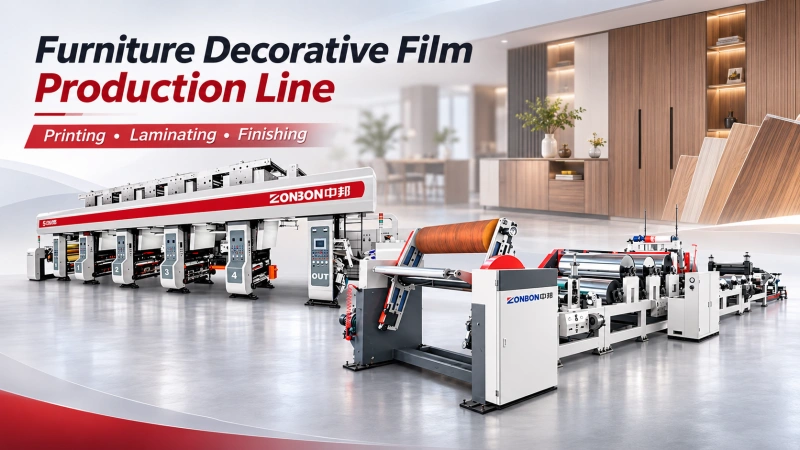
A Decorative Material Rotogravure Printing Machine may be considered when a supplier plans to produce wood grain, stone-effect or other decorative patterns on compatible films or papers, particularly for repeat orders that justify the printing setup.
Before selecting equipment, buyers should evaluate the required printing width, substrate compatibility, number of colors, registration performance, drying conditions and frequency of design changes.
Printing capacity must also be considered alongside actual order quantities. A machine designed for high-volume production may not deliver the expected economic benefits when orders are small or designs change frequently.
Why Printing Alone May Not Be Enough for Furniture Decorative Films
A beautifully printed wood grain pattern does not necessarily mean the material is ready for its final furniture application.
Some decorative products require additional layers, surface textures or protective structures. For example, certain PVC decorative films use multilayer constructions to achieve their intended appearance and processing characteristics.
For suppliers planning compatible two- or three-layer PVC decorative materials, a Decorative Material Laminating Machine can be evaluated for the lamination and embossing stages, depending on the required film structure and production conditions.
Embossing can add surface texture that complements a printed wood grain design, while the selected film construction influences the finished material’s handling and application properties.
It is important to distinguish decorative film lamination from furniture board lamination. Equipment designed to combine PVC film layers is not automatically suitable for bonding decorative surfaces directly onto MDF or other furniture panels.
Suppliers should therefore confirm the actual film structure and manufacturing route before deciding which equipment is necessary.
Should You Invest in Both Machines at the Same Time?
Not every furniture decorative film supplier needs to establish a complete production line immediately.
A business that already purchases printed film but wants to produce specific multilayer PVC materials may initially focus on lamination and embossing. Another supplier with existing downstream processing capabilities may benefit from bringing pattern printing in-house first.
The appropriate investment sequence depends on which manufacturing stage creates the greatest operational limitation.
|
Current Business Situation |
Equipment Strategy to Evaluate |
|---|---|
|
Dependence on outside suppliers for printed decorative patterns |
Consider in-house decorative gravure printing |
|
Existing printed PVC films require compatible multilayer construction and embossing |
Evaluate decorative material lamination equipment |
|
Plans to control both decorative printing and multilayer PVC processing |
Assess an integrated production plan with suitable supporting equipment |
|
Low or unpredictable decorative film demand |
Compare continued outsourcing before investing in machinery |
Even when both machines are required, their production capacities should not be assumed to match.
Working width, operating speed, material handling, changeover time and process requirements must be reviewed individually. Intermediate winding, inspection, slitting or other operations may also be necessary.
A production line should be designed around realistic saleable output rather than the maximum advertised speed of individual machines.
The Costs Furniture Suppliers Often Overlook
When comparing in-house manufacturing with purchasing finished decorative films, the machinery quotation is only the beginning.
Printing cylinders, raw materials, utilities, factory space, operator training, maintenance and production waste can all influence operating costs. Frequent design changes may also increase setup time and reduce effective productivity.
For example, a supplier producing a small number of popular wood grain patterns in large quantities may have different production economics from one offering hundreds of designs in limited batches.
A useful financial comparison starts with the total annual cost of outsourced decorative materials and the estimated cost of producing equivalent saleable materials internally.
The calculation should also account for equipment investment, depreciation, financing, working capital and possible downtime.
Rather than assuming that in-house production will automatically reduce costs, buyers should calculate the expected annual production volume and test several demand scenarios before committing capital.
Before Requesting a Machine Quotation, Check These Five Things
A meaningful equipment quotation starts with clear production requirements. Furniture decorative material suppliers should prepare the following information before contacting machinery manufacturers.
- Finished material samples: Provide representative decorative films or papers showing the expected appearance, texture and quality.
- Material structure: Specify the substrate, layer composition, thickness range and any required coating or embossing process.
- Working width: Confirm the usable finished width, allowing for trimming, material handling and process limitations.
- Production targets: Describe expected order volumes, pattern changes, operating schedules and required saleable output.
- Quality requirements: Identify acceptable color variation, registration performance, surface defects and relevant downstream application tests.
Whenever possible, suppliers should request material trials using their actual substrates and representative designs. Sample evaluation and factory acceptance testing can help identify compatibility problems before shipment.
A successful investment is not simply about purchasing the fastest or most automated machine. It is about selecting a production process that supports the company’s materials, customers and long-term operating requirements.
Conclusion
For furniture suppliers considering decorative film production, the first decision is not which machine to purchase. It is which parts of the supply chain the business needs to control.
In-house printing may improve control over decorative patterns and color consistency, while suitable lamination and embossing equipment can support the production of specific multilayer PVC decorative materials.
By evaluating customer demand, finished material specifications, production capacity and total investment costs before ordering equipment, suppliers can build a manufacturing strategy that supports sustainable business growth without unnecessary capital expenditure.